Walk down any street in Hoi An's Old Town and roughly every other tailoring shop has the word "bespoke" on the storefront. Almost none of those shops are doing bespoke in the sense the word originally meant — and for the most part, the customers do not know the difference. This guide explains, precisely, what bespoke means versus made-to-measure versus off-the-rack, what each of those things actually delivers in fit and lifespan, and how to identify true bespoke when you encounter it. We are a tailor shop ourselves; the disclosure is at the bottom of every page on this site.
The honest claim of this article is that the distinction matters more than the marketing departments of the global tailoring industry would like it to. Once you understand what each term actually means, you stop being confused about why a $300 "bespoke suit" in Hoi An is priced at $300 and a £6,000 bespoke suit on Savile Row is priced at £6,000. They are not the same product wearing different price tags. They are different products.
The Three Categories, Properly Defined
The international tailoring industry recognizes three categories of made garments, with reasonably precise definitions agreed upon by people who actually do the work. Marketing departments blur these lines deliberately. Here is the version that craftspeople use.
Off-the-rack (OTR), or ready-to-wear
The garment is cut from a standard size pattern, sewn by a factory in volume, and hung on a rack in a store. You buy the closest size to your body. Alterations to the hem, sleeve length, and waist are typically possible after purchase but do not change the fundamental shape of the garment. Brooks Brothers, Suitsupply, J.Crew, Banana Republic, Hugo Boss, most department-store suiting — all OTR. The fit is constrained by how close your body is to the pattern's standard sizing assumptions.
Made-to-measure (MTM)
The garment starts from a pre-existing factory block pattern that the shop has on file. Your measurements are entered into a digital or paper system, and the pattern is adjusted by a defined set of variables — chest circumference, sleeve length, jacket length, waist suppression, trouser leg taper, and so on. The fabric is then cut to that adjusted pattern and sewn. There is typically one fitting after the suit is roughed out, with limited adjustments possible at that stage.
Indochino, Suitsupply MTM, Black Lapel, most online "custom" services, and the overwhelming majority of "bespoke" shops in Hoi An, Bangkok, and tourist-destination tailoring markets — all MTM. The fit is significantly better than OTR for most bodies because the variables can accommodate a longer torso, broader shoulders, asymmetric posture (within limits), or a non-standard chest-to-waist drop. But you are still working from a block pattern. The block pattern was not made for you.
Bespoke (true bespoke)
The garment starts from a paper pattern made individually for your body, drafted from scratch by the cutter using your measurements, posture observations, and body details (sloping shoulders, prominent chest, swayback, asymmetric hips). The cutter cuts the cloth using that pattern, sews the suit half-finished in white tacking thread, and you come back for a basted fitting where the half-finished garment is fitted to your actual body and adjustments are marked with chalk. The pattern is then revised, the suit is re-cut where needed, and you have at least one (typically two or three) further fittings before delivery.
A true bespoke suit is a multi-week process minimum, requires 4–8 hours of cutter time, includes hand-padded canvas in the chest and lapel (the canvas is stitched into shape rather than glued or fused, by hand, with hundreds of small stitches over several hours), hand-attached collar, pick-stitched lapels, hand-finished buttonholes, and working sleeve cuff buttonholes that genuinely button. Savile Row's bespoke houses (Henry Poole, Anderson & Sheppard, Huntsman, Gieves & Hawkes), the senior tailors at the top Hong Kong houses (W.W. Chan, A-Man Hing Cheong), and a handful of true bespoke ateliers in Naples and Florence — these are doing actual bespoke. Pricing is $4,000–$10,000 minimum for a two-piece.
Why the Hoi An Marketing Doesn't Match the Reality
If you walk into a Hoi An shop tomorrow and ask for "a bespoke suit," what you will receive — at almost every shop in the city, including most of the famous ones — is a high-end made-to-measure suit. The terminology was adopted because "bespoke" sounds premium and "made-to-measure" sounds technical. A 2008 UK Advertising Standards Authority ruling tried to limit the use of "bespoke" to true bespoke only; it did not stick globally, and Asian tailoring markets in particular use the term loosely.
This is not a unique sin of Hoi An — Bangkok tailors do the same, and so do many British and American "bespoke" houses that are actually doing high-end MTM. The terminology has been sufficiently corrupted that most customers cannot use it as a reliable signal anymore. What you can do, instead, is ask precise questions about the process. The answers will tell you what you are actually buying.
How to Identify True Bespoke (or What's Missing)
The four signals below distinguish true bespoke from premium MTM. If a shop is doing true bespoke, all four will be present. If three or fewer are present, you are buying very-good MTM, which is fine — but the price should reflect that.
Signal 1: A paper pattern is drafted for you, individually
Ask: "Will my paper pattern be cut individually for me, or are you adjusting an existing block pattern?" A bespoke shop will show you the pattern paper, often with your name and date written on it. The pattern will be filed and kept on the premises so future suits can be cut from the same pattern (with adjustments for body changes over time). An MTM shop is adjusting a block pattern in software or by hand; there is no individual paper pattern.
Signal 2: The basted fitting
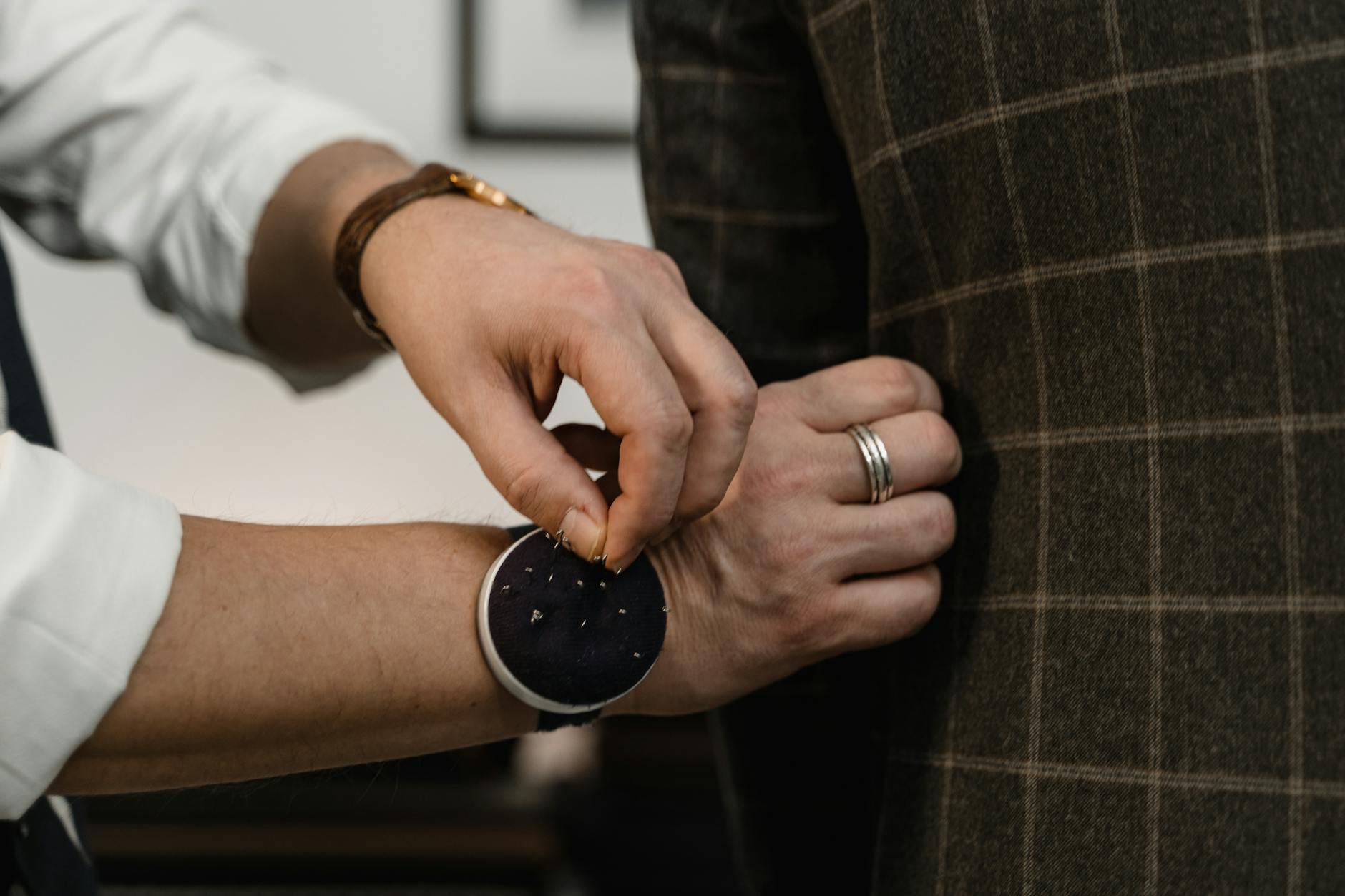
The basted fitting is the central physical signature of bespoke. After your initial measurement, the cutter assembles the suit half-finished in white tacking thread (basting thread), with no lining, no canvas attached firmly, and the seams visible. You put the half-finished suit on, and the cutter walks around you with chalk and pins, marking adjustments — shoulders too square, chest needs more room, lapel rolls too low, sleeve pitch is wrong. The suit then goes back to the workshop to be re-cut where needed, the canvas re-padded, and reassembled.
If your suit goes from "we measured you" straight to "your suit is ready, please come for the fitting," there was no basted fitting. You are doing MTM. A basted fitting requires the cutter to physically build a half-suit and then partially un-build it; that is hours of additional labor and is not done in any MTM workflow.
Signal 3: Hand-padded canvas in the chest and lapel
Inside every well-made suit jacket, there is a layer of stiffening material called the canvas — typically horsehair or a horsehair blend — that gives the chest and lapel their shape. There are three ways to attach the canvas:
- Fused canvas: The canvas is glued to the front fabric with heat-activated adhesive. Found in OTR suits and lower-tier MTM. The glue can delaminate over time and cause "bubbling" on the chest. Common in $50–$150 Hoi An suits.
- Half-canvassed: The chest panel has sewn canvas, but the canvas in the lower jacket and lapels is fused. A reasonable mid-tier compromise. Common in $150–$350 Hoi An suits.
- Fully canvassed (machine-stitched): The canvas is sewn to the front fabric throughout. Better drape, no bubbling, longer lifespan. Common in $300+ Hoi An suits.
- Hand-padded canvas: The canvas is stitched to the lapel and chest panel by hand, with hundreds of tiny "pad stitches" that gradually shape the canvas as it is sewn. This is the bespoke standard. The lapel rolls more naturally and the chest holds shape more durably than any machine-padded equivalent. Found only in true bespoke at $1,000+ price points.
Ask: "Is the canvas fused, machine-stitched, or hand-padded?" A shop doing actual bespoke will know exactly what the question means and will answer specifically. A shop doing MTM will often answer "yes, fully canvassed" and stop there.
Signal 4: Hand-stitched buttonholes
The buttonholes on a true bespoke suit — particularly the boutonnière hole on the left lapel and the working cuff buttonholes — are stitched entirely by hand, with silk thread, in a tight gimp-and-purl construction that takes 20–40 minutes per buttonhole. They have a slightly raised, ropy texture and the stitches are visible to the eye on close inspection. Machine buttonholes are flatter, faster (a buttonhole machine cuts and stitches in 30 seconds), and visually cleaner but lacking the texture.
This is one of the easiest tells. Look closely at the buttonhole on the lapel of a finished suit. If the stitches are uniform, flat, and slightly machined-looking, it is a machine buttonhole. If they are slightly raised, the gimp thread is visible underneath the purl stitches, and there is a visible handcraft variation, it is hand-stitched. Many premium MTM operations now offer hand-finished buttonholes on the lapel only as an upgrade option; full hand-stitched buttonholes throughout (every cuff button, every fly-front button) is bespoke standard.
What MTM Actually Delivers — And When It's the Right Choice
If the above sounds like a takedown of MTM, it is not meant to. Made-to-measure is the right answer for most travelers to Hoi An. Here is why.
True bespoke takes 4–8 hours of cutter time, multiple fittings spread over weeks, and costs accordingly. A genuine bespoke suit in Hoi An — at the small handful of shops actually doing it — would price at $1,500–$3,000 minimum, which is 3–5x the typical Hoi An customer's budget. The marginal fit improvement of bespoke over high-end MTM is real but modest: perhaps 15–25% better fit precision, particularly for non-standard body shapes (significant posture asymmetry, very broad shoulders, very narrow chest-to-waist drop). For 80% of customers with broadly typical body shapes, premium MTM with three fittings produces a suit that looks excellent and fits very well.
What MTM gives you that OTR cannot: a suit that is dimensionally cut to your measurements rather than a standard size. What MTM does not give you that bespoke does: a pattern made from scratch for your body, a basted fitting, and the kind of construction polish that a senior cutter can build into a garment when there is no software-defined block pattern constraining the work.
The honest pricing logic is this:
- $129–$199 MTM: Wool-blend, half-canvas, two fittings. Fit is much better than OTR. Acceptable for occasional wear.
- $200–$400 MTM: Pure wool from a named mill, full or half-canvas, three fittings. Fit is excellent for typical body shapes. The Hoi An sweet spot.
- $400–$700 MTM: Premium Italian fabric (VBC, Reda Super 130s+, Loro Piana entry), full canvas, three fittings, hand-finished details. The fabric is the upgrade.
- $1,000+ true bespoke: Paper pattern, basted fitting, hand-padded canvas, hand-stitched buttonholes throughout. Available only at a small handful of Hoi An shops, and verify the four signals before paying. More commonly priced at this level in Hong Kong and Savile Row.
What Hoi An Shops Actually Deliver — Tier by Tier
To translate this into the Hoi An market specifically:
Tourist-trap shops ($50–$150) are doing OTR-with-alterations dressed up as MTM. They have a few standard sizes pre-cut or rough-cut in the back, and they make minor adjustments (hem length, sleeve length, waist taper) before handing you the suit. The fabric is overwhelmingly polyester or polyester-viscose blend with fused interlining. This is the source of the "Hoi An tailoring is a scam" reviews.
Mid-market established shops ($150–$400) are doing genuine MTM. They use block patterns adjusted to your measurements, cut and sew specifically for you, offer two to three fittings, and use real wool from named mills at the upper end of the tier. The "bespoke" on their signage is marketing — what you receive is well-made MTM. This is where most Hoi An customers should land.
Upper-tier Hoi An shops ($500–$800) are doing high-end MTM with premium fabric and additional construction polish. A small number have a senior cutter capable of doing actual bespoke for their highest-paying customers, but rarely. The fabric is the meaningful upgrade — Holland & Sherry, Dormeuil, Loro Piana — not the construction.
Genuinely bespoke ateliers in Hoi An exist but are rare and not typically marketing to tourists. If you are committed to true bespoke, ask explicitly about the four signals (paper pattern, basted fitting, hand-padded canvas, hand-stitched buttonholes), and budget $1,500+ minimum. Honestly, for true bespoke at any volume, Hong Kong and Savile Row are the better destinations.
Where We Sit, and Why
We are upfront that Nathan Tailors does premium made-to-measure, not bespoke. We use block patterns adjusted to your measurements, cut and sew individually for each customer, offer three fittings (or remote equivalent for online customers), and use full canvas construction with named Italian mill fabric (VBC, Reda, Marzotto, Dormeuil at the upper tier). Our buttonholes are machine-stitched with hand-finishing on premium tier suits. Our pricing reflects what we actually deliver — $149–$499 for a two-piece, the upper end being premium-fabric MTM, not bespoke.
If you want true bespoke, we will tell you honestly that we are not the right shop and refer you to the small handful of Hoi An ateliers, or to Hong Kong, that genuinely do it. That kind of referral happens in our shop maybe twice a year — most customers, when they understand what bespoke actually costs and requires, are happy with premium MTM. Our full menu and pricing is published openly so you can see exactly what tier you are buying.
The Practical Takeaway
If you are reading this guide before walking into a Hoi An tailoring shop, here is what to do with the information:
- Ignore the word "bespoke" on the storefront. It is marketing. Use the four-signal test to decide what you are actually being offered.
- Decide which tier you actually want. Most travelers should target premium MTM ($200–$400). True bespoke is a specialist purchase at a specialist price point.
- Ask precise questions. "Is the canvas fused, machine-stitched, or hand-padded?" "Do you cut a paper pattern individually for me?" "Is there a basted fitting before the final fitting?" The answers tell you what tier the shop is actually operating in.
- Pay for what you want, not the marketing. A $350 high-end MTM suit you wear 200 times is a better purchase than a $1,200 "bespoke" suit that turns out to be the same MTM with prettier marketing.
The honesty principle of this guide is that bespoke and MTM are different products at different price points doing different things. Once you know which one you are buying, the rest of the decision is just about fabric and tailor reputation.