For most visitors, walking into a Hoi An tailor shop for the first time is the only time they will ever commission a piece of custom clothing. The shop is unfamiliar, the language is partly translated, the prices are negotiable in ways most retail is not, and there is a quiet pressure to make decisions quickly. None of this is necessary. A first tailor visit, properly conducted, is a calm, slightly slow, slightly old-fashioned experience that leaves you with a garment you will own for a decade. This guide is what we wish every first-time visitor knew before they pushed through the door.
One thing to settle before we begin: there is nothing about your body that a tailor has not seen before. Hoi An tailors collectively measure tens of thousands of bodies a year. Your concerns — height, weight, asymmetry, posture, the small thing you have been quietly self-conscious about — are routine. The cutter's job is to read your body accurately and build a garment that flatters it. Your job is to stand still and answer a few questions. The transactional weirdness most people feel about a tailor visit fades within the first ten minutes.
The First Thirty Minutes
A well-run first visit follows a predictable rhythm. If your shop deviates significantly, that is itself a signal — usually that they are running a different business than custom tailoring.
Minutes 0–5: Greeting and intake
You walk in, someone greets you, you are offered tea or water. You explain in broad strokes what you are looking for — a wedding suit, a business suit, a casual blazer, two pairs of trousers. The staff member listens, asks one or two clarifying questions (event type, color preference, your timeline in Hoi An), and walks you to the fabric library. The intake should take five minutes. If a shop tries to push you toward an immediate order before you have seen any fabric, leave.
Minutes 5–25: Fabric selection
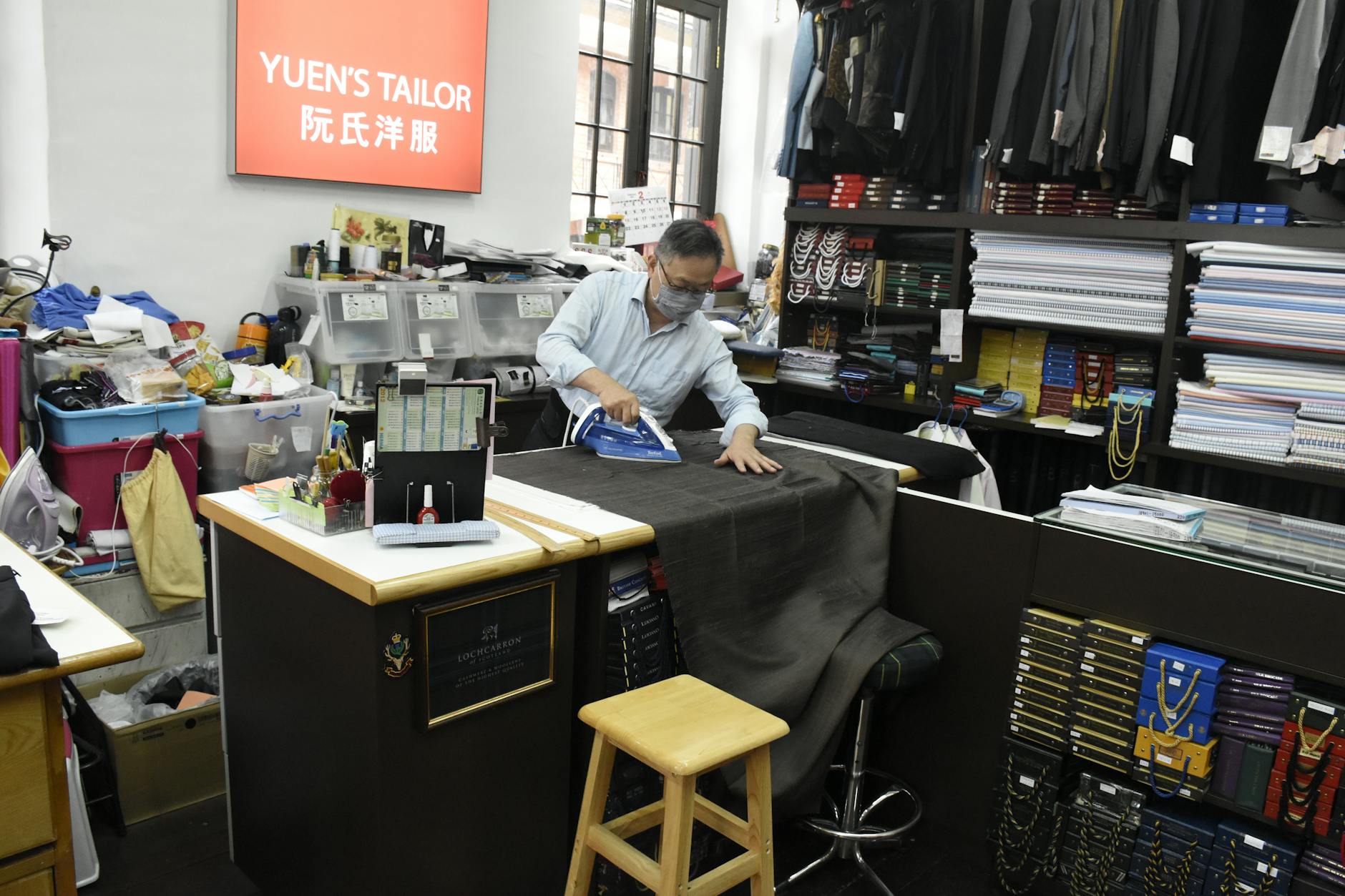
The fabric library is the heart of a serious tailor shop. At a well-stocked shop you will see between 200 and 500 bolts arranged by category — wools, blends, linens, cottons, lining materials, shirt fabrics. The cutter or the sales advisor (sometimes the same person at smaller shops) will pull bolts for you to handle. They will ask about your color preference, the suit's purpose, and your climate at home, and pull cloth that fits the brief.
This is the moment to slow down. Touch the fabric — the hand of the cloth tells you more than the label does. Crumple a corner gently and watch how it recovers. Hold the bolt up against your face in natural light to see the color. Ask to see the selvedge edge where the mill name is woven; a serious shop will show you happily.
Minutes 25–35: Style discussion
Once you have selected a fabric (or narrowed to two options), the style discussion begins. This covers the construction details: number of buttons, lapel style, vent count, pocket type, lining choice, button stance, trouser style, hem finish. A good cutter will guide you through these decisions rather than overwhelming you with all of them at once. Most people make about ten style decisions for a suit; we will go into them in the next section.
Minutes 35–60: Measurement
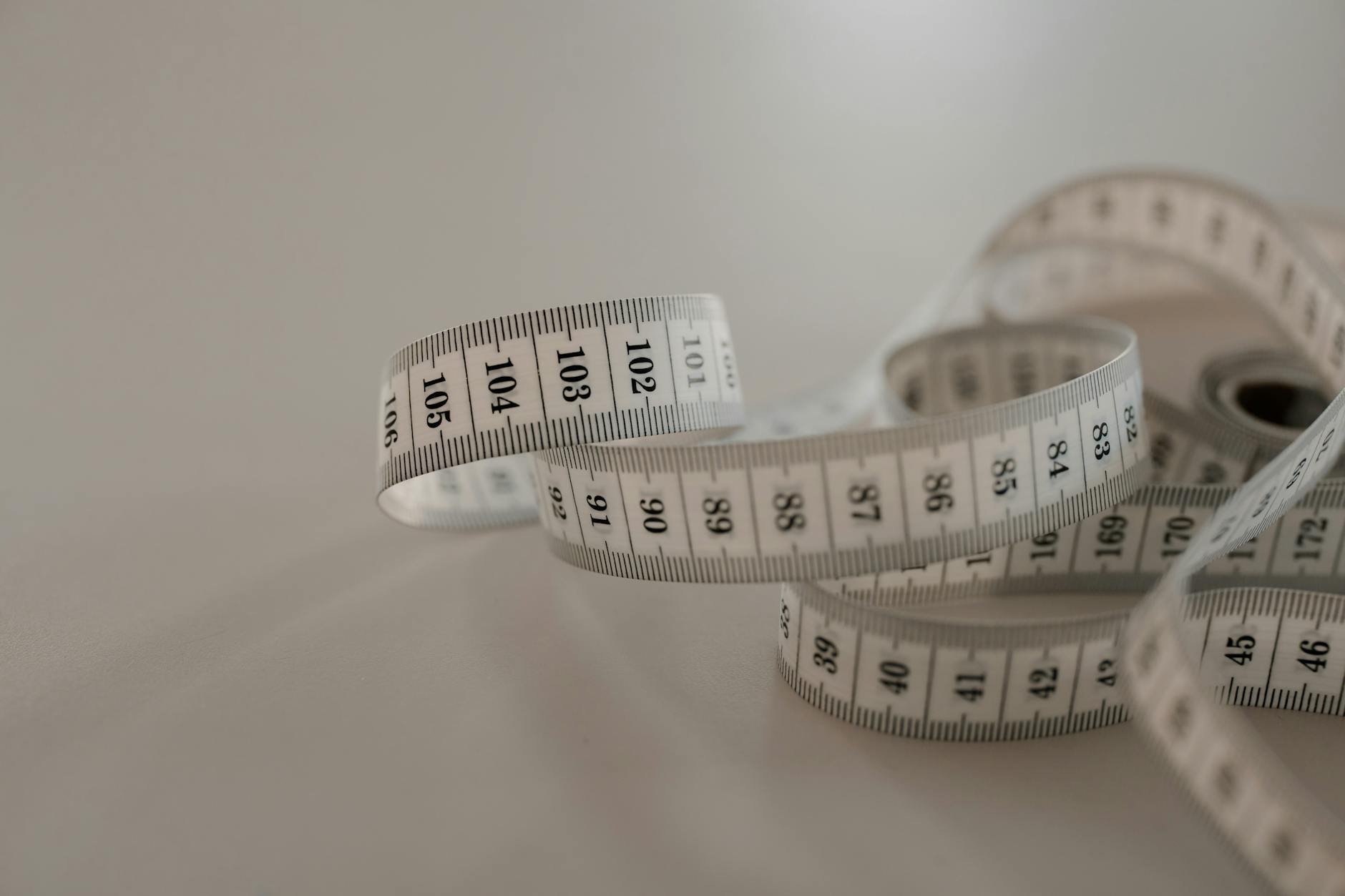
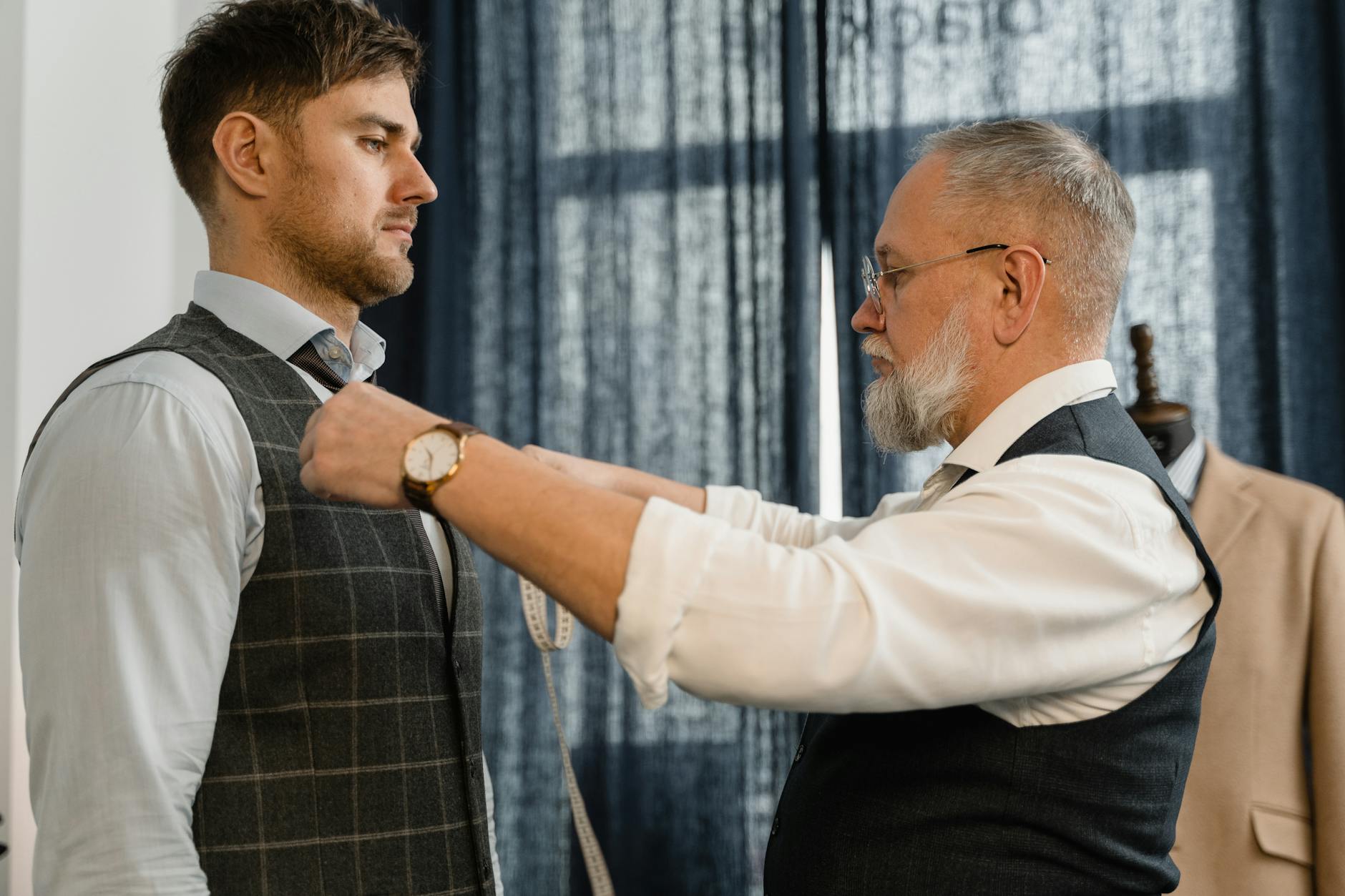
The measurement process is the most physically intimate part of the visit and the part most first-time customers are quietly anxious about. The cutter takes 18–25 individual measurements with a soft tape — chest at the fullest part, shoulder seam to seam, sleeve length from shoulder point to wrist bone, jacket length from collar to hem, waist at the natural waistline (not where you wear your trousers), seat at the fullest part, trouser inseam, trouser outseam, neck circumference for shirt-and-collar fit, bicep, wrist, thigh, calf if relevant, and several diagonal measurements like front-shoulder-to-waist that capture posture.
You stand normally. The cutter works around you, sometimes calling out numbers to a second person who writes them on a measurement sheet. The whole process takes 15–25 minutes. You will be touched lightly — the tape against your shoulder, your arm raised gently to measure under-arm, the tape across your chest. None of this is unusual. None of it is sexualized. If at any point you are uncomfortable, you can ask the cutter to pause or explain what they are measuring next.
The Fabric Library: How to Read It
The fabric library is where most of the suit's outcome is determined. A few principles for reading a library well.
The bolt arrangement tells you about the shop
Reputable shops arrange bolts by category and quality tier — usually wool by mill or country of origin (Italian wool, British wool, Korean wool), then by color family. A library that is arranged randomly, or that mixes mill cloth with unmarked bolts indiscriminately, is signaling a shop that does not differentiate quality carefully. A library that has every bolt labeled with mill name, weight, and price is signaling transparency.
Weight matters as much as fiber
Two bolts of pure wool can perform completely differently if one is 8 oz and the other is 12 oz. Ask the weight of any bolt you are seriously considering. A summer suit and a winter suit are different garments — make sure your fabric matches your use case. We covered this in the fabric guide; the short version is 8–10 oz for hot climates and summer, 9–11 oz for year-round, 11–13 oz for cold-weather wear.
Color in the library, not in the photo
Phone-camera photos are unreliable for fabric color. The same navy bolt looks different under the shop's LED lighting and under your hotel's natural light. Pull the bolt to a window if possible, or step outside the shop with the bolt for a moment. Reputable shops welcome this.
The Style Discussion: Translation Guide
The terminology of a tailor visit is one of the things that can make first-time customers feel out of their depth. The honest version: most of these style choices are minor, and a good cutter will give you a default if you ask for one. Here is what each decision actually means.
- Number of buttons: Two-button (modern default), three-button (slightly more traditional, hides waist), one-button (more formal, used for tuxedos). For a first suit, two-button.
- Lapel style: Notch (modern default, slight V at the lapel join), peak (more formal, points up toward the shoulder), shawl (rounded, used for tuxedos and dinner jackets). For a business suit, notch. For a wedding or evening suit, peak is striking.
- Lapel width: Modern default is 7.5–9 cm. Wider lapels (9–11 cm) are coming back into fashion as of 2026; narrower lapels (5–6 cm) read as dated. If unsure, ask for "modern medium."
- Vents: Single vent (one slit at the back, slightly more casual), double vent (two slits, modern formal default), no vent (rare, used for some Italian-cut suits). For most uses, double vent.
- Pockets: Flap (most common, formal), patch (casual, used on blazers and sport coats), jetted (very formal, used on tuxedos). For a business suit, flap.
- Lining: Full-lined (jacket fully lined inside, more formal), half-lined (lining only in the back, lighter and more breathable), unlined (rare, very casual). For a hot-weather suit, half-lined is significantly more comfortable.
- Trouser style: Flat-front (modern default, slim), pleated (more traditional, more room in the seat). For a first suit, flat-front.
- Trouser hem: Plain (modern default), cuffed (more formal, slightly more vintage). For a business suit, plain.
- Buttons: Horn, mother of pearl, plastic. Horn is the upgrade; ask whether it costs extra (sometimes does, sometimes does not).
- Working sleeve cuffs (functional buttons): The buttons on the sleeve actually unbutton, signaling a higher-end suit. This is sometimes called "surgeon's cuffs" and used to be a custom-only feature. Ask if it is included.
Questions to Ask the Tailor
Most first-time customers ask too few questions. The shop expects to be asked questions; asking signals you take the order seriously, and the shop will treat you accordingly.
- "Can I see the selvedge edge of this bolt?" This verifies the mill name woven into the cloth.
- "What is the weight of this fabric?" Critical for matching to your climate.
- "How many fittings are included?" Two minimum, three is better. One fitting is too few.
- "Where will the suit be made?" A serious shop has its own workshop and will tell you. A retail-front shop will deflect.
- "Can I see the workshop?" You do not need to physically tour it; the response to the question is what you are watching.
- "Is the canvas floating or fused?" A floating canvas (also called full canvas or half-canvas) is hand-stitched into the jacket front and lasts decades. A fused canvas is glued and bubbles after dry-cleaning. For any serious suit, ask for floating canvas.
- "What is your remake policy if the suit doesn't fit when it arrives?" Relevant if you are getting the suit shipped. Reputable shops offer free remake or partial credit.
- "Can I see a finished suit you have made recently?" Most shops have sample garments on display. Look at the buttonhole stitching, the lapel roll, the lining attachment.
Red Flags From the Shop
The following responses signal a shop you should leave:
- "Just choose, we will discuss price after measuring." Reputable shops are transparent about pricing upfront. Hidden pricing is leverage for upselling once you are emotionally committed.
- "Don't worry about the fabric, we use the best." A serious shop is happy to name the mill. "We use the best" is a phrase used when there is no specific mill to name.
- "This will fit perfectly with one fitting." A first cut never fits perfectly. One-fitting tailoring means the suit is approximate rather than properly fitted.
- "Why don't you also order a shirt and a tie? Special price for you." Some upselling is normal; aggressive upselling that doesn't take "no" gracefully is a tell about the shop's priorities.
- "You should also order another suit, two for one promotion." Sometimes legitimate, often a steering tactic toward cheaper fabric or rushed construction. Order one suit first, see how it goes, then add.
- "Take a deposit, we send the suit and you pay rest later." Reputable shops have clean payment terms — typically 30–50% deposit on order, balance on completion. Anything more elaborate is suspicious.
How Payment Works
Hoi An tailoring is mostly cash-and-card, mixed. The conventions:
- Deposit on order: 30–50% of the total at the first visit, after measurement, before cutting begins. This is universal across reputable shops.
- Balance on completion: The remainder when you collect the finished garment, after the final fitting confirms the suit fits.
- Currency: Most shops accept USD, VND, EUR, AUD. Card payment is increasingly available but cash is still preferred at smaller shops. Asking the conversion rate before paying is normal.
- Card surcharge: Some shops add a 2–3% credit card surcharge. Ask before paying. This is standard regional practice and not a scam.
- Receipts: Always ask for a written receipt with the total, deposit, balance, and pickup date. Take a phone photo of it.
For remote orders, payment is usually 100% upfront via international wire, branded checkout, or PayPal. At our shop the remote workflow is on a Stripe checkout linked from nathantailors.com; other shops have their own systems. Confirm payment method before committing.
Handling the "You Should Also Order…" Pressure
Almost every Hoi An tailor will suggest additional items during your first visit. "While we have your measurements, why not a shirt? An extra pair of trousers? A waistcoat?" Some of this is legitimate — additional pieces tailored from the same measurements while the cutter is engaged with you can be excellent value. Some of it is upselling pressure.
The honest navigation:
- If you actually want additional pieces, get them. A custom shirt at $35–60 is the single best-value item in a Hoi An tailor shop, and most travelers regret not ordering more shirts.
- If you don't actually want them, decline politely and firmly. "Maybe next time" or "Let me see how the suit goes first, then I'll think about it." A reputable shop will accept the decline and move on. A shop that pushes harder is signaling something.
- Avoid same-day decisions on multiple items. Order the suit on Day 1. If on Day 2 you want to add a shirt or trousers, the shop can usually accommodate. Stretching out decisions over two days reduces buyer's remorse.
What to Wear to the Fitting
For your first visit (the measurement), dress should make accurate measurement possible:
- Close-fitting clothing. A thin t-shirt and slim trousers. Thick clothing makes accurate measurement difficult.
- Dress shoes you intend to wear with the suit. Trouser break is calibrated to shoe height. If you only have sneakers in Hoi An, tell the cutter what shoes you wear at home so they can adjust.
- Thin belt or none. The trouser waist is fitted to your natural waist, not over a belt.
- Hair off the neck if it is long. The cutter measures collar and shoulder; long hair in the way creates errors.
For subsequent fittings, the same dress code applies, plus any other garments you plan to wear under the suit (a dress shirt, a vest if relevant). The fitting is calibrated to how you will actually wear the suit, not to a hypothetical bare-chested version.
Closing Thought
A first tailor visit is supposed to feel slightly slow and slightly old-fashioned. The cutter handles fabric, the tape goes around your shoulder, the chalk marks the cloth. The pace is deliberate because the work is deliberate. If your visit feels rushed, transactional, or pressured, that is the shop telling you something — and you have other options. The good Hoi An tailors run an unhurried first visit because they want you to leave feeling certain about the order, not pressured into it.
If you would like to start your visit at our shop or with a remote consultation before arriving, we are reachable on WhatsApp and we typically respond inside an hour during Hoi An waking hours. Whatever shop you choose, take your time with the first visit. The thirty extra minutes spent handling fabric and asking questions are the highest-leverage thirty minutes of the entire suit-making process.