Hoi An has roughly 400 active tailoring shops within and around the Old Town. The majority are honest operations of varying quality. A meaningful minority are running well-rehearsed scams on travelers who have not done the homework. The good news is that the scams are largely the same six or seven patterns repeated over and over — once you can recognize them, the city becomes much easier to navigate. This guide names them, explains how each one works mechanically, and gives you the specific verification steps that will protect you. We are a tailor shop ourselves; the disclosure is at the bottom of every page on this site.
The hard truth, before getting into specifics: the Hoi An scam economy exists because the volume of one-time visitors is enormous and the consequences of cheating any individual customer are small. A traveler with three days in town who gets sold a polyester suit as wool will probably never return, will probably leave a single Google review months later that gets buried under newer reviews, and will not file a tourism complaint with the Vietnamese authorities. The scam shops know this. The protection against them is your own awareness, not the legal system.
Scam 1: Polyester Sold as Wool
The single most common Hoi An tailoring scam, by orders of magnitude. The mechanic is straightforward. The customer asks for a "wool suit" and a price quote. The shop quotes $80–$150, marketing the cloth as "wool" or "Italian wool" or sometimes a fictitious mill name. The customer pays, the suit is made, and the cloth is in fact polyester or polyester-viscose blend with a fully fused (glued) interlining. The suit looks acceptable in photos and on day one. After two or three dry-cleanings, the fused interlining bubbles and delaminates, the lapel rolls incorrectly, and the chest loses its shape.
Why this is mathematically certain at low price points
A meter of genuine wool from any named Italian mill costs the shop $25–$45 wholesale. A two-piece suit takes about 3.2 meters of suiting fabric. That is $80–$144 in fabric cost alone, before lining, canvas, buttons, labor, rent, or margin. If a shop is selling a "wool suit" for $80 retail, the fabric is mathematically not wool. Even at $130 retail, the math is tight enough that the cloth is overwhelmingly likely to be a blend (60–80% wool, 20–40% polyester or viscose) rather than pure wool. Marketing language ("100% wool feel", "premium Italian-style") is engineered to leave the customer with a misimpression without crossing into provable fraud.
How to verify before you commit
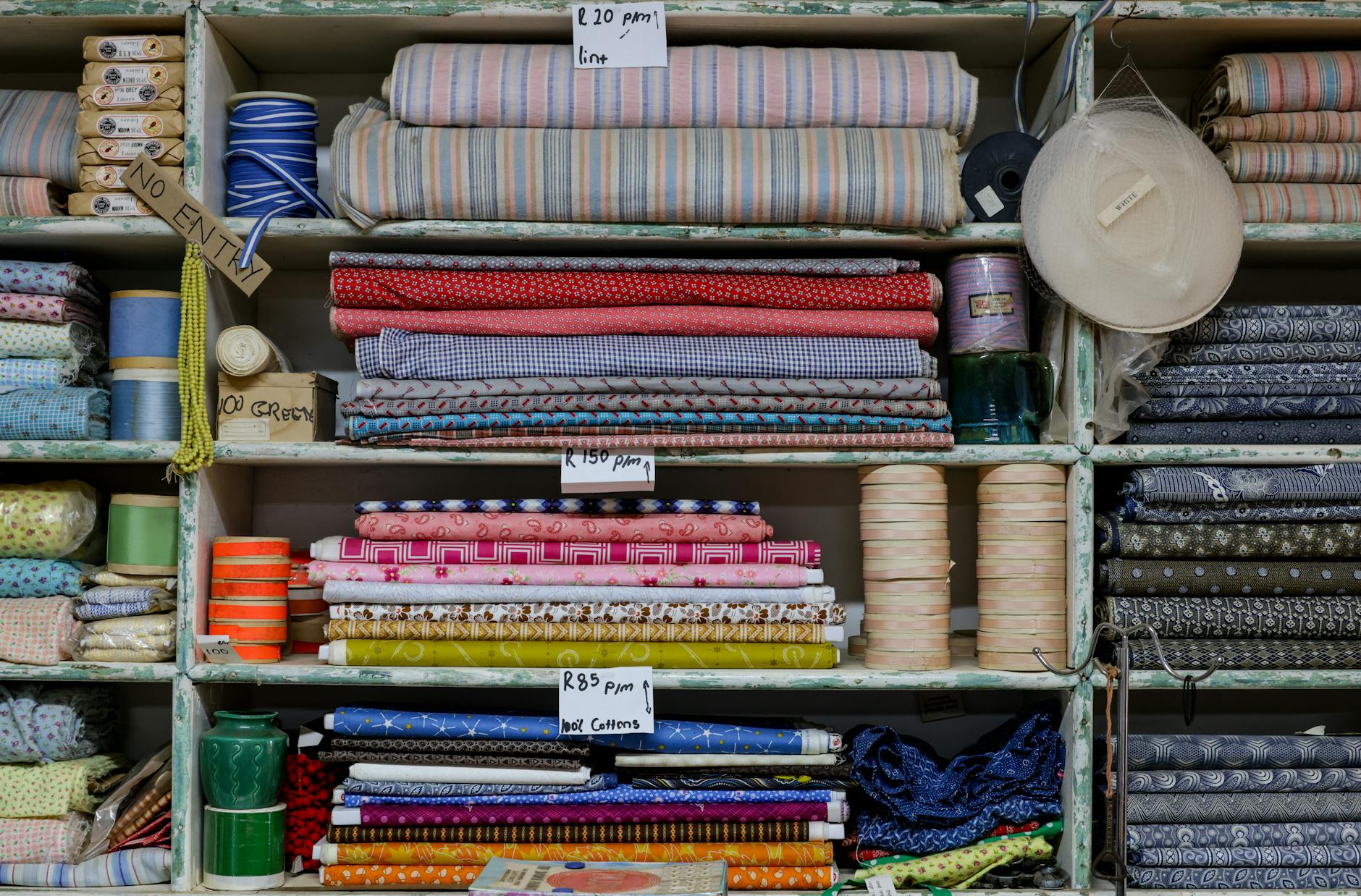
The selvedge test. The selvedge is the finished edge of the cloth that runs along the length of the bolt. Real Italian and English mills weave their name into the selvedge in tiny letters. Pull a bolt off the shelf and look at the edge. "Vitale Barberis Canonico" / "VBC", "Reda 1865", "Marzotto", "Drago", "Cerruti", "Loro Piana", "Holland & Sherry", "Dormeuil", "Scabal" — these are the names that should appear. If the selvedge has no woven mill name, or has only generic Chinese-character or Korean markings, the cloth is not from a named premium mill regardless of marketing.
The crumple test. Real wool is springy. Crumple a section of the cloth in your fist, hold for five seconds, then release. Real wool will recover most of its shape within 30 seconds, with a few faint creases that fade further over the next few minutes. Polyester blend will hold the wrinkle longer, sometimes permanently. Pure polyester will hold the wrinkle indefinitely.
The burn test (if you can get a swatch). Real wool burns slowly, smells like burning hair, and self-extinguishes when pulled from the flame. Polyester burns fast, smells like burning plastic, melts and drips, and continues burning. You will not do this in the shop, but you can do it on a swatch you bring home. Reputable shops will give you a small fabric swatch on request.
What to do if it happens
If the suit is delivered and you suspect it is not the wool you paid for, the practical reality is that recovery is difficult once you have left Vietnam. The shop will deny, the swatch will have been "from a different bolt," and Vietnamese consumer protection law is not effectively enforced for tourist transactions. The protection is upstream: verify the cloth before you commit. If you are still in Hoi An and within the dispute window, demand to see the bolt the cloth was cut from, ask for the selvedge with the mill name, and refuse to pay the balance until you have verified.
Scam 2: Fused Interlining Hidden Under Marketing
A subtler but equally common scam. The cloth itself is real wool, but the interlining (the canvas inside the jacket that gives the chest and lapel their shape) is fully fused — glued with heat-activated adhesive rather than sewn. The shop markets the suit as "fully canvassed" or simply "premium construction" without specifying. The customer doesn't know to ask the difference between fused, half-canvassed, machine-stitched canvassed, and hand-padded canvassed.
Fused interlining bubbles and delaminates over time, particularly after dry-cleaning or in humid environments. A fused-canvas suit looks fine for the first six months, develops faint chest bubbling around month 12, and becomes visibly compromised by month 24. A real canvassed suit holds its shape for 5–10+ years.
How to verify
Ask the question directly. "Is the canvas fused, machine-stitched, or hand-padded?" A shop doing real canvassed construction will know the answer immediately. A shop running this scam will deflect ("yes, fully canvassed" without specifying), claim "all our suits are canvassed" without being able to demonstrate the difference, or change the subject to fabric.
The pinch test on a finished suit. Pinch the front of the jacket between your fingers — grab the outer fabric in one hand and the lining in the other, and try to pull them apart. In a properly canvassed suit, you should feel a third layer (the canvas) floating between them; the canvas is sewn, not glued, so it has a small amount of independent movement. In a fused suit, the layers are bonded and feel like a single thicker piece of fabric.
The chest flex test. Hold the jacket by the shoulders and push the chest forward gently. A canvassed jacket will flex with a soft, springy resistance. A fused jacket will feel slightly stiffer and more board-like.
Scam 3: Fabric Bait-and-Switch After Deposit
The customer enters the shop, handles a beautiful piece of cloth (often a genuine premium fabric from a named mill), agrees to a price, and pays a deposit. When the suit is delivered, the cloth is visually similar but is in fact a cheaper alternative — same color, same approximate weight, lower mill provenance. The customer rarely notices because the deposit is paid and the visual difference between an upper-tier wool blend and a real Super 130s is subtle.
How to protect yourself
Photograph the bolt at the moment you select. Take a photo of the bolt with the selvedge visible (mill name woven in), the price tag if displayed, and the fabric pattern. This is your evidence if the delivered suit appears different.
Ask for a swatch. A reputable shop will cut a small swatch (5cm x 5cm) from the bolt at the time you commit and give it to you with a note of the bolt number. The delivered suit should match that swatch exactly. A shop that refuses to give you a swatch is signaling something.
Keep the deposit small. 30% is reasonable; 50% is the most you should pay before seeing the cut cloth. Some shops demand 100% upfront; this is a yellow flag and a meaningful loss of leverage if the bait-and-switch happens.
Inspect the cloth at the first fitting before committing further. The first fitting is your last meaningful checkpoint. Compare the cut cloth in the half-finished suit against the swatch you took at order. If the patterns are different, raise the issue then, not at delivery.
Scam 4: "Free" Gifts That Lock You Into Bad Orders
The shop offers "free" upgrades or gifts as part of the package — a free silk shirt, a free silk tie, a free pair of trousers — bundled into a multi-suit order. The marketing math is compelling: "Order three suits, get a fourth shirt and tie free, total $899." The actual math is that the bundled suits are individually overpriced ($300 each suit, when comparable mid-market quality runs $200–$250) and the "free" items have a true wholesale value of $20–$40 in polyester or low-grade silk. The customer feels they are getting a deal; the shop is collecting a $250+ premium across the bundle.
This scheme is most common in shops that work with tour groups and tuk-tuk drivers (see Scam 6 below). It is also common at shops that combine high pressure with friendliness — the "we are giving you a special price because we like you" routine.
How to identify and resist
Ask for unbundled per-item pricing. If the shop will quote three suits at $899 with a free shirt and tie, ask for the price of one suit alone, two suits alone, and three suits alone — without the "free" items. A legitimate volume discount might run 5–10% off per additional suit. A scam bundle is usually inflating the per-suit price by 20–30% and giving back $30 of "free" items to make the customer feel rewarded.
Be willing to walk. The free-gift scheme depends on the customer feeling locked in. If you say "let me think about it" and the shop drops the price 30% the moment you head for the door, you were being scammed at the original price. A reputable shop has stable pricing and does not negotiate dramatically when you walk.
Scam 5: Kickback Drivers Steering You to Specific Shops
The mechanic: a tuk-tuk driver, hotel concierge, or "friendly local" who strikes up conversation steers you toward "the best tailor in town" — a shop you have not researched. They walk you in, introduce you to the owner, and disappear. The shop then pays the driver/concierge a 15–25% commission on whatever you spend. The price you pay is inflated by exactly that commission.
This is not a Hoi An-specific scam (Bangkok, Marrakech, and Istanbul have variants), and it is the single most common way unprepared travelers end up at a poorly-rated shop. The driver will be confident and pleasant. The shop will be set up to look respectable on first impression. Neither is a reliable signal.
How to avoid
Do not let drivers or concierges select your tailor. The basic discipline is to research before you arrive (this guide and the "best Hoi An tailors 2026" guide are starting points), have one or two specific shop names in mind, and tell drivers explicitly "to [Shop Name] please" rather than "to a good tailor." Hotel concierges in respectable hotels will sometimes give honest recommendations, but the same incentive structure can apply — if your concierge is unusually insistent on a specific shop, treat the recommendation skeptically.
Walk in cold to verify reviews. If a driver has dropped you at a shop you did not research, do not order on that visit. Take the shop's name, walk out, look up Google reviews filtered by date (past 6 months), and decide whether to return. The kickback scheme depends on closing the customer in the moment.
Scam 6: Fake Mill Labels
A more sophisticated variant of the polyester-sold-as-wool scam. The shop has stocked bolts of cloth — possibly real wool, possibly blend — with counterfeit labels woven into the selvedge claiming famous mill provenance. "Loro Piana", "Holland & Sherry", or "Dormeuil" labels are sewn or woven into mid-tier cloth that the customer is then sold at a premium. The customer verifies "yes, the selvedge says Loro Piana", pays $500 for a "Loro Piana suit," and walks away with $200 worth of generic Korean wool.
This is harder to defend against than the basic polyester scam because the verification step (selvedge name) has been spoofed. The protection is partly intuition (the price is significantly below market for real Loro Piana — a Loro Piana suit at $400 is too cheap to be real) and partly verification through additional channels.
How to verify mill authenticity
Price discipline. Real Loro Piana cloth costs the shop $90–$140 per meter wholesale. A two-piece suit needs ~3.2 meters, so the cloth alone is $290–$450 wholesale. A "Loro Piana suit" priced at $400–$500 retail is mathematically not real Loro Piana. Holland & Sherry and Dormeuil are similar; expect $700+ retail minimum for a genuine premium-mill suit.
Mill bolt cards. Genuine Italian and English mills supply numbered bolt cards or hangtags with each bolt of cloth. The hangtag will have the mill's logo, the bolt number, the cloth code, and often a pattern image. Reputable shops display these on or near the bolt. Counterfeit-label shops typically cannot produce the matching hangtag.
Tactile verification. Real Super 130s wool from Loro Piana or VBC has a specific drape and hand that experienced tailors and fabric merchants can identify on touch. If you have access to a friend who has shopped at a verified premium house (Hong Kong, London, or a top-tier Hoi An shop), bring them with you to verify.
Scam 7: The Day-3 Pickup Scheme
Less common but well-documented. The customer orders a suit on day 1, has a fitting on day 2, and is scheduled to pick up on day 3 — the last day of their trip. On day 3, the shop produces a suit that has been substantially altered from the agreed specification (different lining, different button style, sometimes different cloth in subtle ways) and presents it as the finished product. The customer, with a flight to catch, has limited leverage. They either accept the altered suit or forfeit the deposit.
A variant: the shop "loses" the suit and offers the customer a "comparable" suit from stock at a discount. The "comparable" suit is a stock garment that did not fit a previous customer, now being recycled. The customer pays for a custom suit and receives a barely-altered ready-to-wear.
How to protect yourself
Schedule pickup at least 24 hours before your departure. If your flight is at 6 PM on Saturday, schedule pickup for Friday morning, not Saturday afternoon. This gives you a buffer to reject the suit, demand corrections, or escalate to other shops if the result is unacceptable.
Inspect at pickup before paying the balance. Try the suit on, walk in it, sit in it, raise your arms, button and unbutton. Compare the cloth and details against your photos and swatch from the original order. If anything is wrong, do not pay the balance until it is corrected.
Photograph the suit at every stage. Initial fabric selection, basted/half-finished fitting, final fitting, and pickup. The photo trail is your evidence if a dispute arises.
What Your Rights Actually Are
The honest read on consumer protection: Vietnamese consumer law exists and theoretically protects tourists, but enforcement for one-time visitors is minimal. The Hoi An tourist police will hear complaints but rarely act on them. Your practical rights are:
- Refusal of the balance payment. If a suit is materially different from what you ordered, you can refuse to pay the remaining balance. The deposit is typically already with the shop.
- Dispute on the credit card. If you paid by credit card, particularly with a major US or European card, you can file a chargeback for a substantially-not-as-described product. Document with photos and written communication.
- Public review. Google reviews are read by future customers and shops monitor them. A specific, factual review with photos is the highest-leverage tool you have. Vague rants are easily dismissed; specific documentation ("ordered Holland & Sherry, received cloth with no mill marking, see photo") is not.
- Tourism authority report. Vietnam's tourism authority (Vietnam National Administration of Tourism, in Hanoi) accepts written complaints. Outcome is uncertain, but the report exists in the record and can affect a shop's licensing over time.
None of these are strong enough to count on. The protection is upstream — verify before paying.
How Legitimate Shops Differentiate Themselves
The shops doing real work in Hoi An tend to share certain practices that the scam shops cannot easily fake:
- Published pricing. A shop that publishes its menu and per-fabric pricing online ahead of your visit has nothing to hide. Our full menu is on nathantailors.com; this is uncommon in the Hoi An market and is itself a signal.
- Willingness to show the workshop. A real shop is proud of where the suits are made. "Can I see your workshop?" is a question that separates real operations from retail-front scams.
- Multiple fittings included. Two minimum, three preferred. A shop that is rushing you toward "24-hour delivery" is skipping the step where the suit gets adjusted to your body.
- Transparent fabric discussions. The good shops will pull the bolt off the shelf, point to the selvedge, name the mill, and let you handle the cloth before discussing price. The scam shops want you to commit before you have seen anything properly.
- Senior cutter consistency. Single-workshop shops or shops with a defined head cutter give every customer the same person. Multi-branch operations vary; the reputable ones will tell you which cutter you will be working with.
- Long-form online reviews from the last six months. Recent, specific, photographed reviews are more reliable than older reviews. A shop with strong reviews from 2018 and mediocre 2025 reviews has slipped.
The Underlying Discipline
Most Hoi An tailoring scams work because the customer is rushed, undereducated, and feels obligated by the relationship the shop has constructed. The discipline that defeats most of them is simple: verify before paying, document at every stage, and be willing to walk away.
If you do those three things, the shop's incentive to cheat you collapses. The scams depend on customers who will not verify, will not document, and will not walk. The good shops in Hoi An know this and welcome the verification — it is the bad shops that get nervous when you ask to see the selvedge or take photos. Treat that nervousness as data.
The honest closing thought: most Hoi An tailors are not running scams. They are running competent mid-market operations that produce serviceable to excellent suits at a fraction of Western prices. The scam minority is loud enough to dominate the negative-review narrative, but it is a minority. With the verification habits above, you can navigate the city safely and end up with the kind of suit that is the reason people come to Hoi An in the first place.