From the Library
Faifo, 1635: The Year the Silk Ships Stopped Coming
How a stretch of riverbank in Quảng Nam became a clearinghouse for Japanese, Chinese and Portuguese silk between roughly 1593 and 1635 — and what stayed behind.
May 25, 2026
In 1619, a Nagasaki merchant named Araki Sōtarō (荒木宗太郎) sailed home from Faifo with a wife. She was a daughter of the Nguyễn lord — Vietnamese sources name her Nguyễn Thị Ngọc Hoa — and in Nagasaki she became known as Aniô-san, said to be the way she called to her husband: anh ơi. They are buried together at Daionji in Nagasaki. The marriage is not a romance — it is a receipt. It tells us that by 1619 the Nguyễn court in Đàng Trong was close enough to the Tokugawa silk trade to send a daughter inside it.
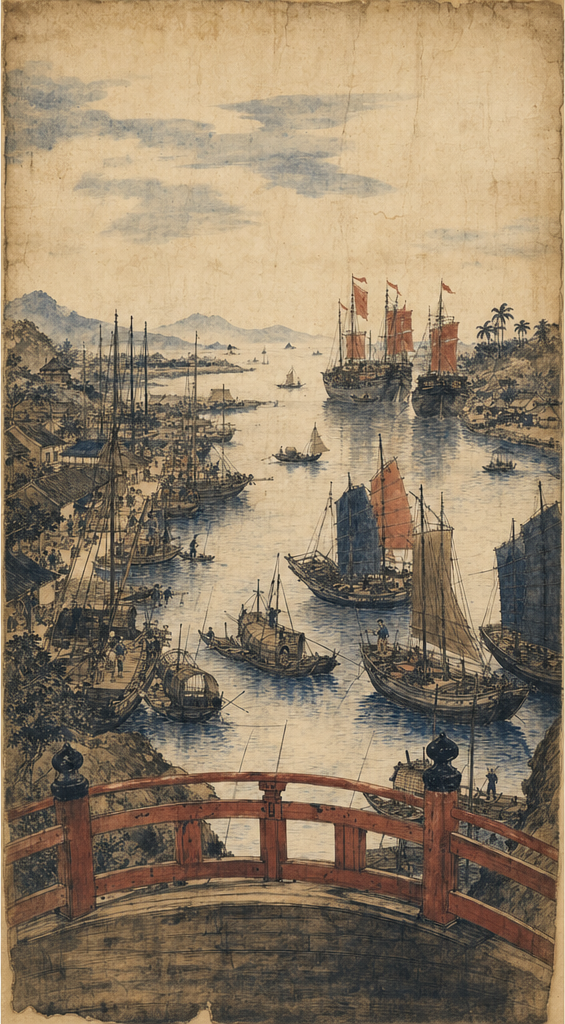
The port that hosted that marriage was Faifo, the foreign name for what Vietnamese called Hải Phố — "seaside town." For about forty years, between roughly 1593 and 1635, it was the working clearinghouse for raw silk moving out of central Vietnam to Japan and China, with Portuguese and later Dutch traders skimming the edges. The Tokugawa shogunate issued shuinjō — red-seal licenses — to a small number of Japanese merchants, and between 1604 and 1635 around 75 of those licensed ships docked at Hội An. They came each year on the southwest monsoon and left on the northeast, buying silk, sugar and cinnamon.
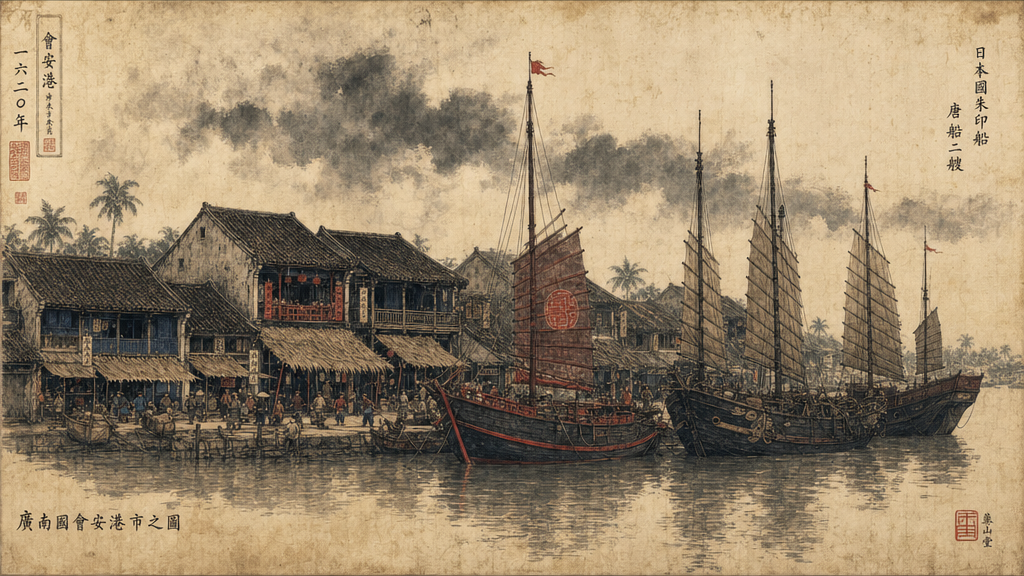
“Vào thế kỉ thứ XVI, cùng với sự phát triển phồn thịnh của thương cảng Hội An, Bến Đò Tơ thuộc làng Mã Châu trở thành điểm giao thương mua bán vải, sợi tơ tằm.”
In the sixteenth century, alongside the flourishing of the trading port of Hội An, the Silk Ferry Landing belonging to Mã Châu village became a point of trade for cloth and raw silk.
— The Bến Đò Tơ — literally Silk Ferry Landing — names the actual upriver dock where Mã Châu silk was rafted down the Thu Bồn to be sold at Faifo.
The town was physically split. A small covered bridge — Chùa Cầu — divided the Japanese quarter on the west bank from the Chinese quarter on the east. Each quarter had its own headman, its own customs. Christoforo Borri, an Italian Jesuit who lived in Cochinchina from 1618 to 1622, described a single long street "three to four leagues long" along the river, "bordered on both sides by closely built houses inhabited by people who came from Fujian." Borri also recorded that silk was so abundant in Cochinchina that ordinary people wore it daily — a sentence to handle gently, since seventeenth-century Jesuits exaggerated for Roman audiences, but a sentence that matches what the ship manifests imply.
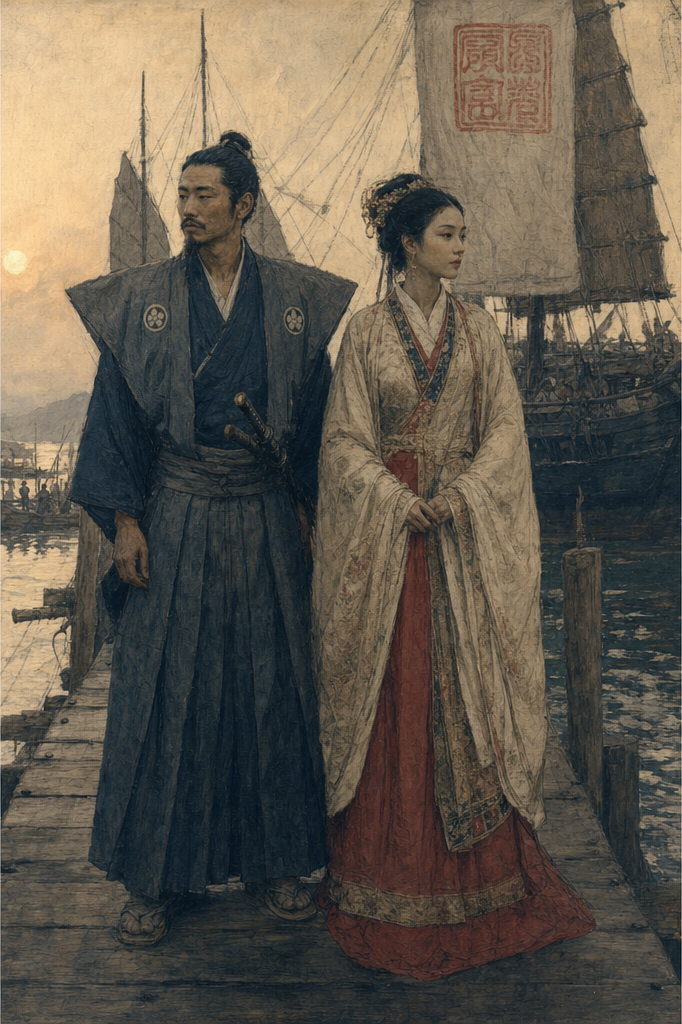
Araki Sōtarō was favoured personally by Lord Nguyễn Phúc Nguyên (r. 1613–1635), who is said to have given him a painting of Quan Âm. Other Japanese merchants left thinner traces: a 1670 letter from a Faifo resident named Shichirobe survives in Japanese archives, and the Japanese governor of the quarter received Alexandre de Rhodes in 1640. By then the trade was already ending. In 1635 the Tokugawa shogunate closed Japan to outbound voyages. The red-seal ships stopped coming. The Japanese quarter slowly emptied; some of its families assimilated, others sailed home.
“廣南所出之貨,無物不有”
Of the goods that come out of Quảng Nam, there is nothing that cannot be had.
— An eighteenth-century Cantonese trader's remark recorded in Wheeler's Hội An manuscript — the line that explains why Chinese huiguan stayed even after the Japanese left.
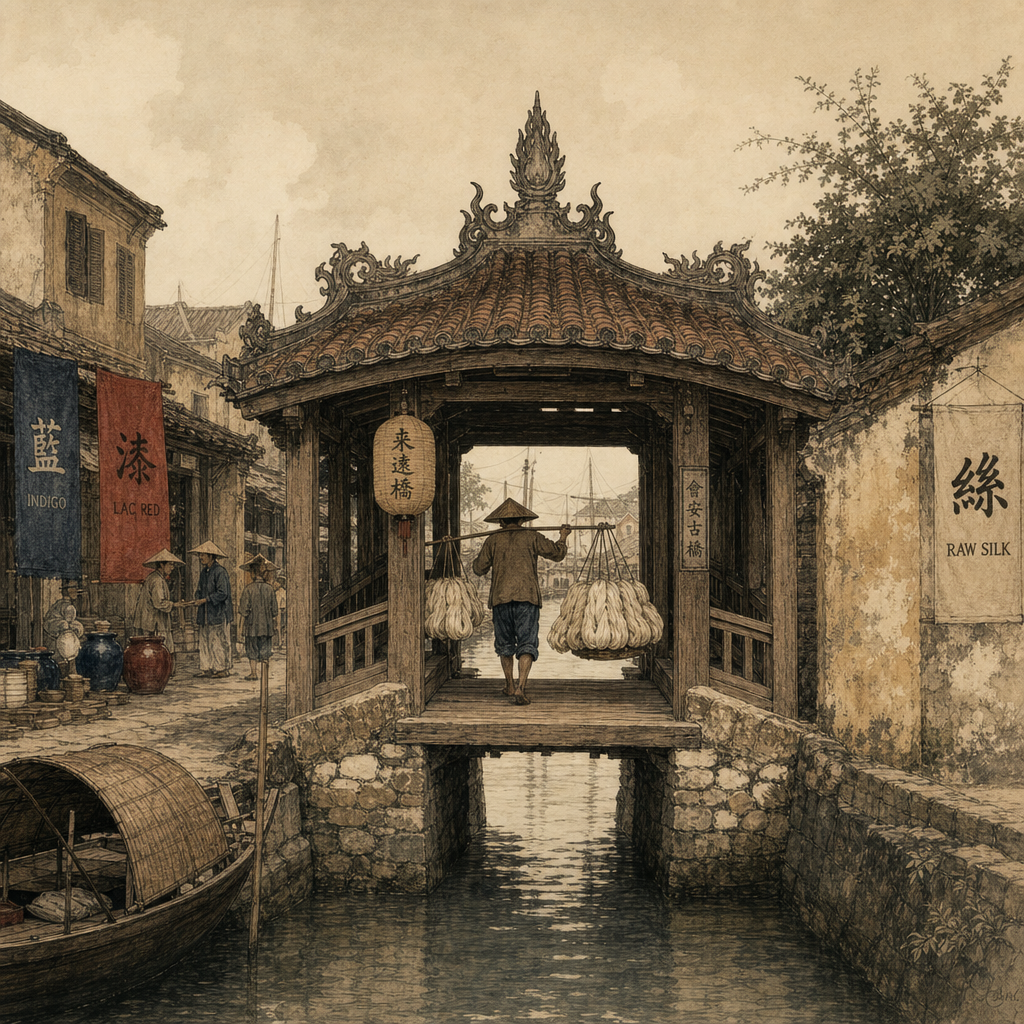
What replaced the Japanese was Chinese. Hokkien, Cantonese, Hainanese, Teochew and Hakka merchants — five bang — built their own assembly halls, the hội quán whose carved beams and stone steles still stand on Trần Phú. Phước Kiến's bell was cast in 1678. Quan Công Temple traces a founding to 1653. The bridge that had been the Japanese boundary was renamed Lai Viễn Kiều — "the bridge of distant guests" — by Nguyễn Phúc Chu in 1719, the new name carved into its plaque in classical Chinese.
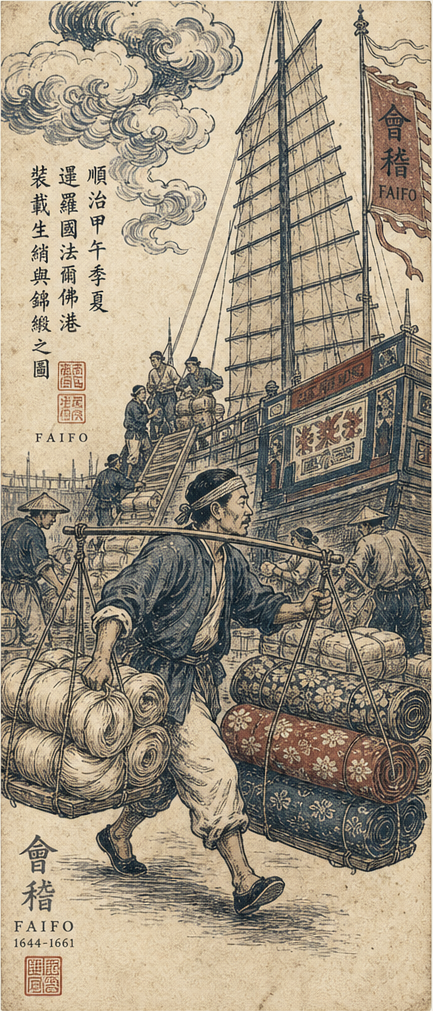
By the time French missionaries and then French customs officers began describing Faifo in the nineteenth century, the silk port was already historical. The river silted, the deep-water trade shifted north to Đà Nẵng, and the assembly halls turned into community shrines for the descendants of merchants whose great-grandfathers had stopped trading. What did not leave was the habit: foreign visitors arriving on a monsoon and commissioning cloth-work from people whose families had been measuring foreigners for four centuries.
When a Korean honeymooner or an Australian on a stopover walks into a shop on Trần Phú today and asks for a jacket cut by Friday, they are doing — without knowing it — a smaller version of what Araki Sōtarō did with a heavier ledger, in 1619, three doors down.
Sources
- 1.Trung tâm Quản lý Bảo tồn Di sản Văn hóa Hội An, ‘Lịch sử – Văn hóa Đô thị cổ Hội An.’ hoianheritage.net, accessed 2026-05-25.
- 2.Charles Wheeler, ‘Living and Trading in Hội An: The Development of a Nguyễn Port in the Seventeenth and Eighteenth Centuries.’ Academia.edu manuscript, accessed 2026-05-25.
- 3.Kyushu Regional Development Bureau, MLIT, ‘The Tale of the Vietnamese Princess Anio and a Nagasaki Merchant.’ qsr.mlit.go.jp, accessed 2026-05-25.
- 4.Christoforo Borri, *Relatione della nuova missione delli P.P. della Compagnia di Gesù al Regno della Cocincina* (Rome, 1631). Reissued in Olga Dror & K. W. Taylor (eds.), *Views of Seventeenth-Century Vietnam* (Cornell SEAP, 2006).(unverified)