From the Library
Mã Châu: The 20-Kilometre Supply Chain Behind Faifo's Silk
Twenty kilometres up the Thu Bồn from Hội An, a Duy Xuyên weaving village has been turning mulberry leaves into court silk for roughly five centuries.
May 25, 2026
The river that empties at Hội An is the Thu Bồn. Follow it twenty kilometres upstream and you reach Nam Phước town in Duy Xuyên district, and inside Nam Phước, a cluster of low houses and mulberry fields called làng Mã Châu — Mã Châu village. The official Hội An port history opens in the late sixteenth century. Mã Châu opens earlier. Local writers and the Đà Nẵng municipal portal both give it roughly six hundred years.
“600 năm hình thành và phát triển, làng lụa Mã Châu tưởng chừng đã thất truyền.”
Six hundred years of formation and development, the Mã Châu silk village was nearly lost.
— The standard framing in Vietnamese press: six centuries of continuity, almost broken in the late twentieth century, now slowly recovering.
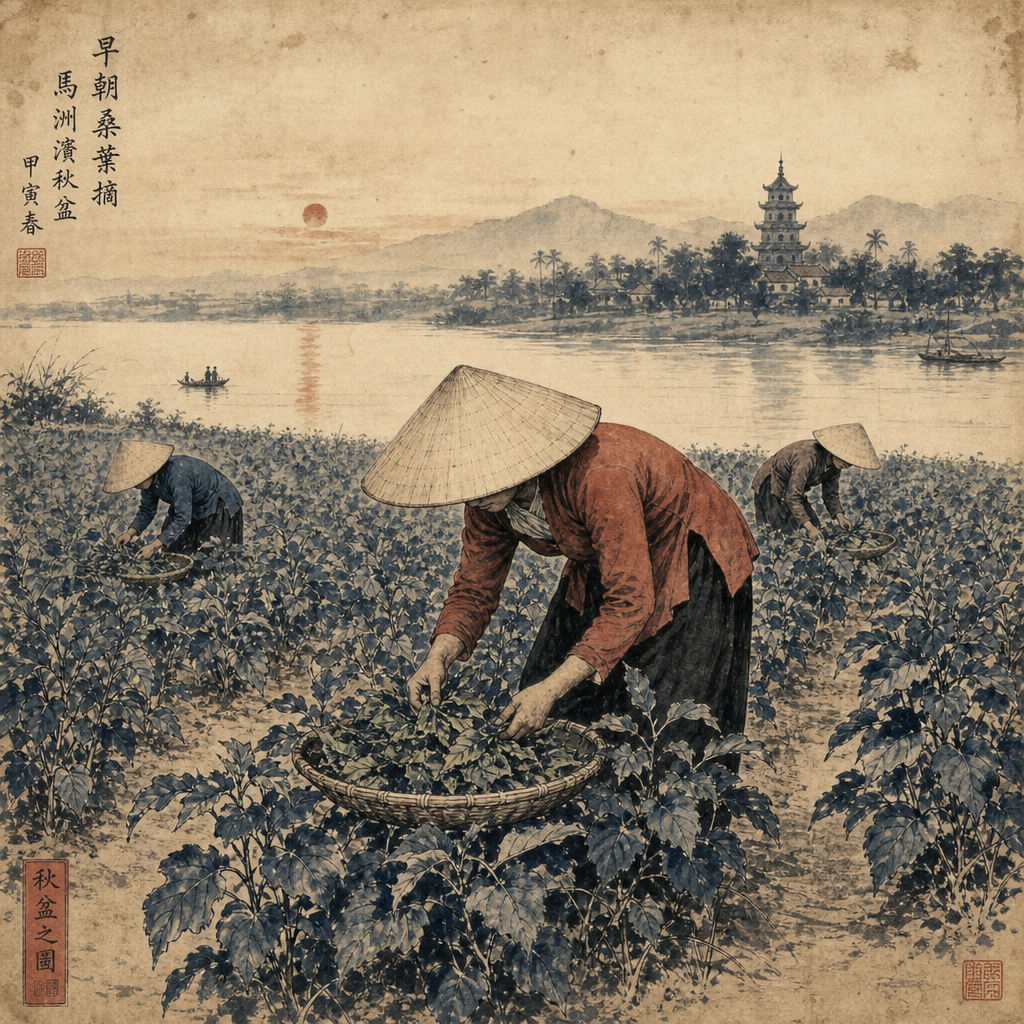
The village's own legend names a founder — bà Mã Châu, a woman said to have carried looms south during the Nam tiến, the centuries-long Vietnamese migration into former Champa territory. Whether the bà existed or is a personification, the timing fits: by the early fifteenth century Đại Việt had taken Quảng Nam, and Vietnamese peasant settlers were planting mulberry on the alluvial flats of the Thu Bồn where Cham weavers had likely worked before them. Sericulture in central Vietnam is older than Mã Châu's village charter; Mã Châu inherits a craft layer it did not invent.
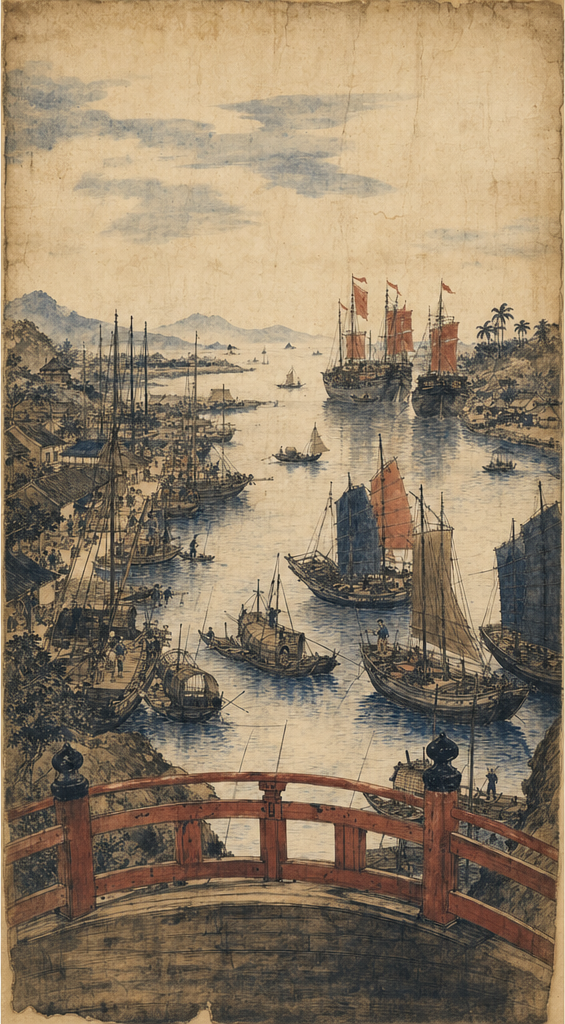
What it did do was scale. By the sixteenth and seventeenth centuries the village was rearing silkworms, reeling silk and weaving cloth in thousands of households, and the bolts moved downstream to Faifo. The municipal sources name the upstream embarkation point: Bến Đò Tơ, the Silk Ferry Landing. From there, raw silk and woven bolts went to the foreign quarters in Hội An — into the holds of red-seal ships bound for Nagasaki, into Hokkien junks bound for Fujian, into Portuguese and later Dutch cargoes.
“Vào thế kỉ thứ XVI, cùng với sự phát triển phồn thịnh của thương cảng Hội An, Bến Đò Tơ thuộc làng Mã Châu trở thành điểm giao thương mua bán vải, sợi tơ tằm.”
In the sixteenth century, alongside the flourishing of the trading port of Hội An, the Silk Ferry Landing of Mã Châu village became a place of trade in cloth and raw silk.
— The single sentence that links Mã Châu directly to Faifo — village, river, ferry, port.
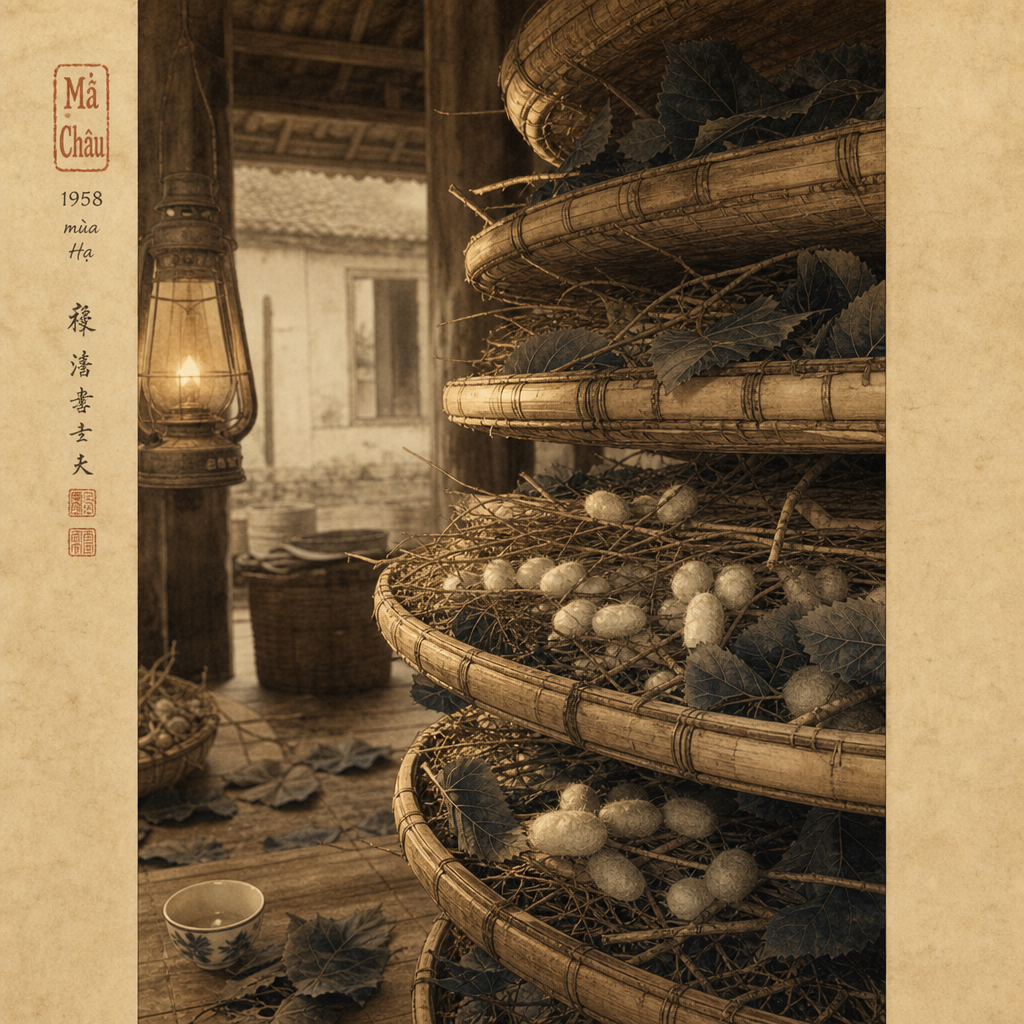
The work itself was — and is — patient. A Nhân Dân profile of the surviving weavers counts roughly twenty steps from mulberry leaf to finished cloth: planting dâu, feeding tằm, soaking the cocoons, reeling, sun-drying, treating with olive-pressed oil before warping the loom. The reporter's description of the cloth is fond and unflattering at once: "Lụa Mã Châu thô, mộc nhưng bền chắc như tính cách thật lòng của người miền trung mình vậy" — Mã Châu silk is coarse and rustic but durable, like the honest character of central Vietnamese people themselves. That coarseness is partly the point: it is not Hangzhou damask. It is working silk.
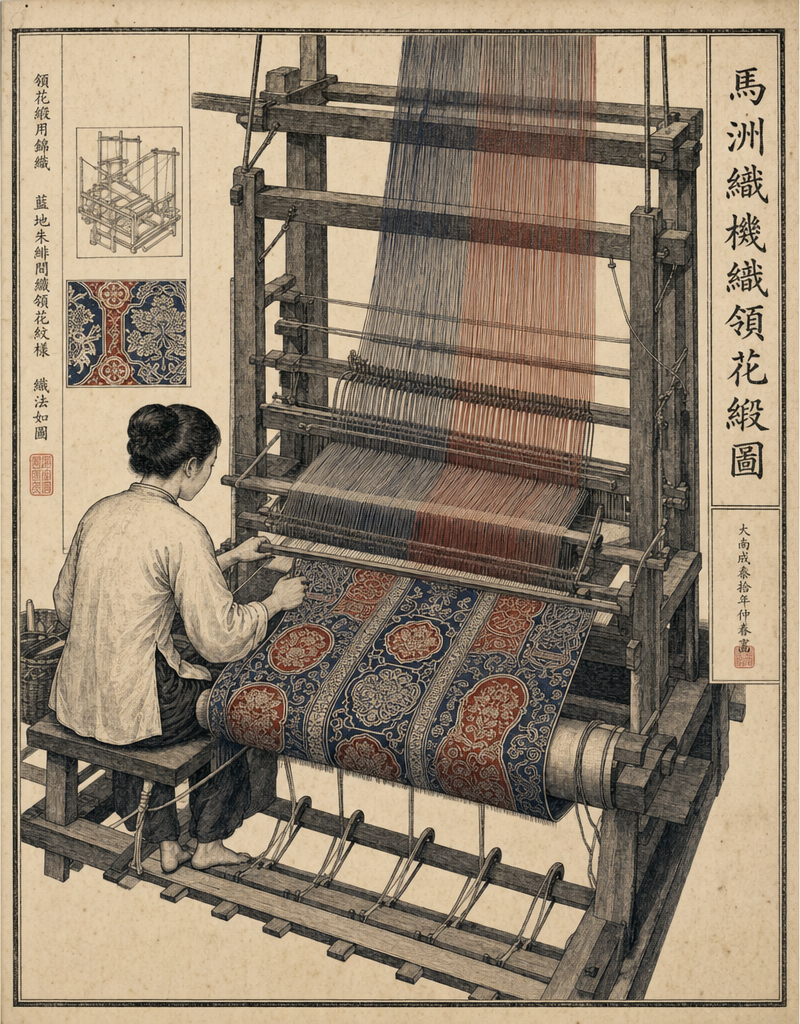
There was a finer register, too. A grade called Lãnh Hoa — flowered lãnh, a glossy patterned weave — was historically reserved for the court. "Lúc xưa, dòng Lãnh Hoa chỉ dành cho cung đình", one revival profile records: in earlier times, the Lãnh Hoa line was for the royal palace only. The Nguyễn court at Huế dressed in silks fed by villages like Mã Châu. So did the áo ngũ thân tunics that Lord Nguyễn Phúc Khoát standardised by decree in 1744 — a five-panel cut whose grammar still lives inside the modern áo dài.
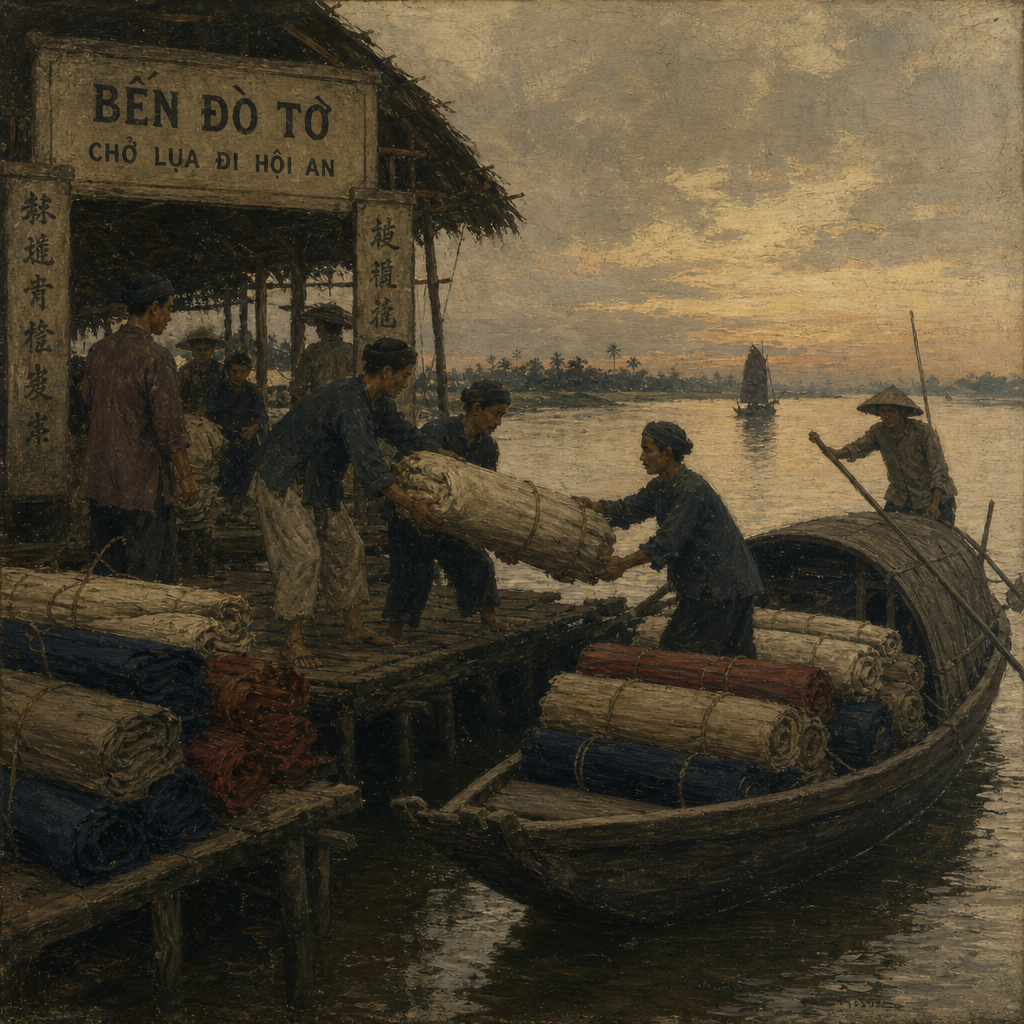
The dye side of the supply chain sat a few villages over. Đông Yên and other settlements in Duy Xuyên handled indigo (chàm) and lac-red (cánh kiến), the two colours that anchor a great deal of period Vietnamese textile. Older Quảng Nam sources sometimes reference bát sắc Quảng — "the eight colours of Quảng" — though the phrase shows up more often in popular writing than in the formal village ledgers we could verify, so we leave it as a tradition worth chasing rather than a documented inventory.
The twentieth century almost killed Mã Châu. Cooperativisation, synthetic fibres, the collapse of the court that had been the patron of the fine grades — by the 1990s the looms were going silent. The Pháp Luật profile traces nineteen generations of one weaving family; the eighteenth generation, Trần Hữu Phương, kept his cooperative running through the lean decade almost alone, and his daughter Trần Thị Yến — the nineteenth generation — came back to it. Today the workshop ships roughly three thousand metres of silk a month.
Stand inside any tailor on Trần Phú and look at the bolts on the high shelf. Some are Chinese. Some are blended. A few — increasingly, deliberately, when you ask — are still Mã Châu. The cloth on the shelf has a river behind it, and the river is twenty kilometres long.
Sources
- 1.Báo Nhân Dân, ‘Duyên tơ tằm làng lụa Mã Châu’ (2023). nhandan.vn, accessed 2026-05-25.
- 2.Báo Pháp Luật TP.HCM, ‘Những người giữ nghề trăm năm – Bài cuối: Lụa Mã Châu 600 năm nổi tiếng bốn bể.’ plo.vn, accessed 2026-05-25.
- 3.Cổng thông tin điện tử thành phố Đà Nẵng, ‘Làng nghề dệt vải tơ lụa Mã Châu – Chạm vào sợi tơ ngàn năm xứ Quảng.’ danang.gov.vn, accessed 2026-05-25.
- 4.Cù Lao Chàm Tour, ‘Làng Lụa Mã Châu – Duy Xuyên.’ culaochamtour.com, accessed 2026-05-25.